
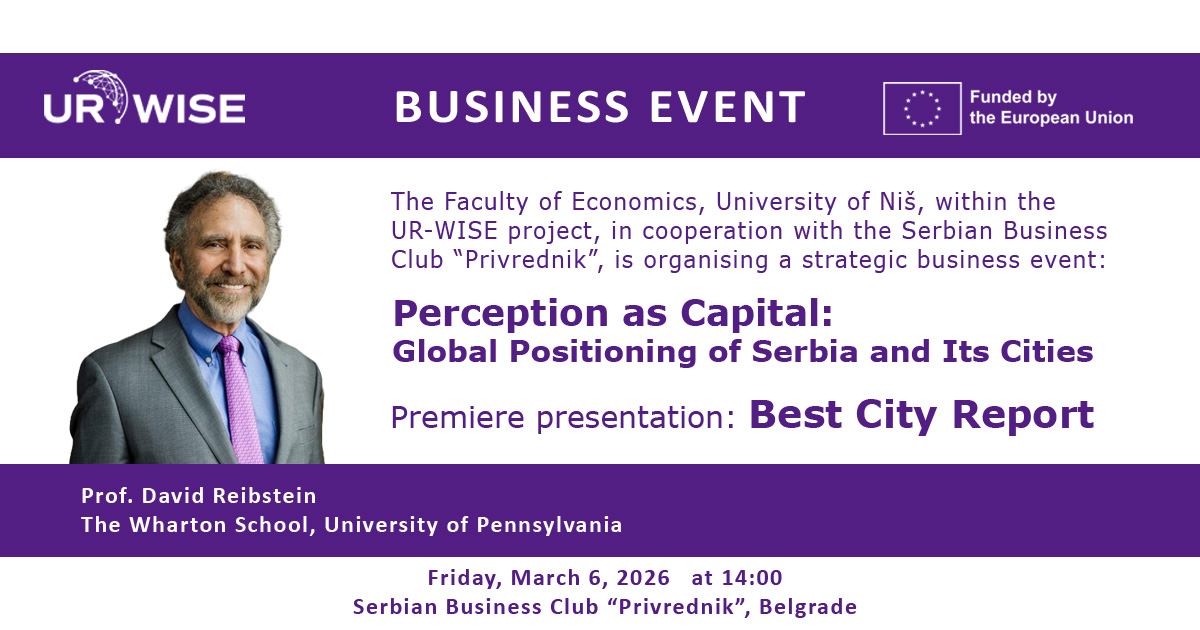
The Faculty of Economics, University of Niš, within the UR-WISE project, in cooperation with the Serbian Business Club “Privrednik”, is organising a strategic business event titled Perception as Capital: Global Positioning of Serbia and Its Cities.
📅 Friday, March 6, 2026 at 14:00
📍 Serbian Business Club “Privrednik”, Šekspirova 27, Belgrade
The central focus of the event will be the improvement of Serbia’s international perception and the positioning of its cities as strategic economic assets, with particular emphasis on implications for business development, foreign investment, and long-term competitiveness.
In the opening segment, strategic guidelines for strengthening Serbia’s global position will be presented based on the U.S. News & World Report – Best Countries Report methodology, a global study first introduced at the World Economic Forum in Davos in 2016.
The research is conducted in cooperation with BAV Consulting and The Wharton School, University of Pennsylvania, with Prof. David Reibstein serving as the lead researcher and principal architect of the methodology. While Prof. Reibstein will present the Best Countries 2025 results at the Kopaonik Business Forum, the Belgrade event will focus specifically on the strategic implications of the framework for Serbia
The event will also feature the premiere presentation of the national Best City Report, conducted by the Faculty of Economics, University of Niš within the UR-WISE project.
The study covers all 28 cities in Serbia, including Belgrade as the capital city, and is based on a survey of 2,000 citizens and 200 opinion leaders (intellectuals, artists, scientists, professors, doctors, and lawyers)
The findings provide in-depth insights into perceptions of quality of life and work across Serbian cities, enabling comparative ranking while identifying key drivers of depopulation, brain drain, and regional development disparities. The conclusions of the study will also be presented at the World Urban Forum in Baku (17–22 May 2026), alongside UN-Habitat’s quality-of-life research results for Serbia, positioning the topic within a broader international policy context.
A dedicated segment of the event will focus on the second phase of the research, which includes surveying 300 business entities across Serbian cities using a representative statistical sample. In this context, cooperation with members of the Serbian Business Club “Privrednik” is of particular importance. The Club is recognised as a key partner in this phase of the research, both as opinion leaders and as a representative voice of Serbia’s leading business community.
Integrating the perspective of the business elite will ensure strategically relevant insights into competitiveness, investment climate, and perceptions of the business environment.
The event aims to open a structured dialogue between academia and business leaders on how reputational capital, at both national and city levels, can be transformed into development capital through strategic perception management, institutional strengthening, and coordinated long-term positioning strategies.